Between The Borders
immigration and society

I wrote this paper during undergrad and I feel as though it is very fitting during current times.
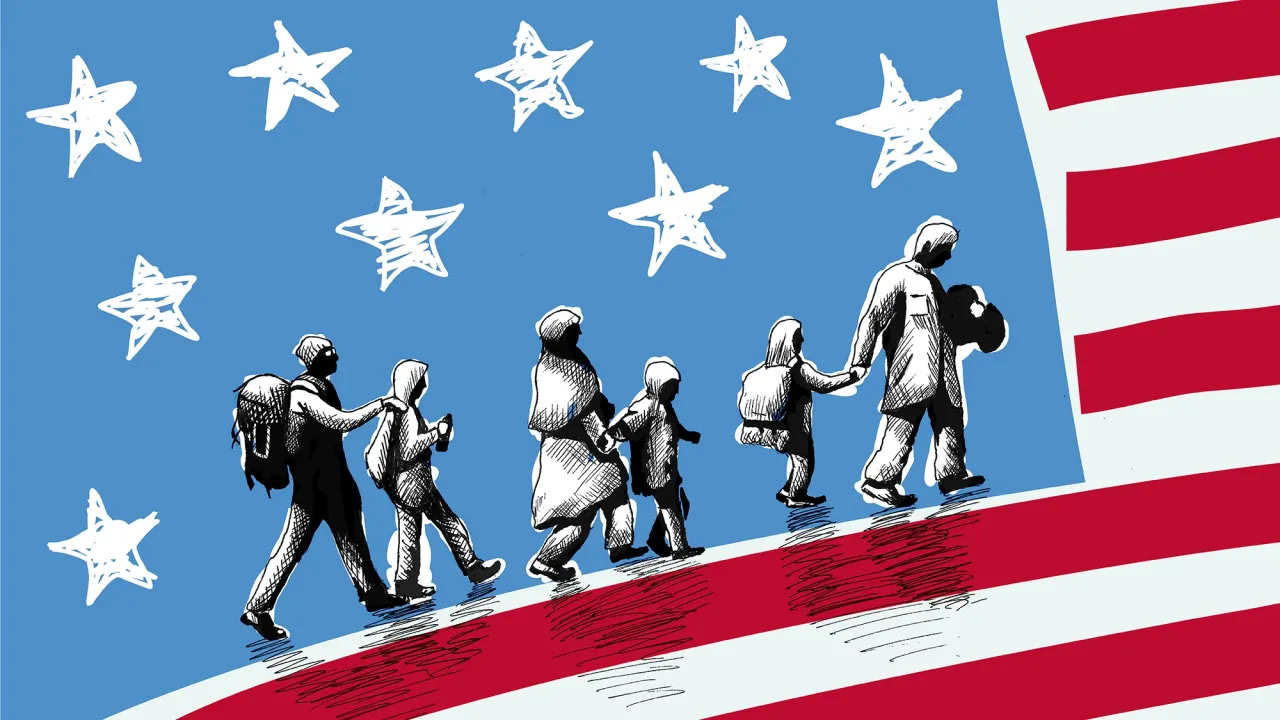
What is the meaning of immigration? At its core, the question arises: What gives us human beings the right to play the role of God in terms of immigration? As countries like the United States contend with the flow of people, borders, and policies, the repercussions of government actions exceed far beyond legal statuses, posing concerns about our commonalities and our responsibilities as representatives of this global community. Nevertheless, immigration is a complex issue involving multiple different facets of life: Asylum seekers, Refugees, Guest workers, undocumented migrants, authorized migrants, etc. Researchers like Walzer argue for the right of the community and heavily push back toward guest worker programs while researches like Carens stress the importance of the right of an individual and the need for open borders. In this analysis, I will argue that although the appeal of guest worker programs is high and somewhat beneficial, expanding programs to attract migrants like Christopher Cruz could lead to an exploitative situation that is harmful for both the employer and the worker; instead I will argue in favor of Caren’s argument on the need for open borders to allow people to move freely across nations and create a flow of different cultures and communities.
Why guest workers? The purpose of guest worker programs is to address labor shortages in specific industries by allowing foreign workers to enter a country temporarily to fill those gaps. Many would argue that expanding guest worker programs serves as a solution to unauthorized immigration.
But I would have to disagree. Christopher Cruz, a 22-year-old migrant, trying to escape the danger of the El Salvadorean gangs resorted to illegal immigration, recognizing the slim likelihood of receiving asylum. In his article detailing Cruz’s story, Kulish reveals something heard way too often: the current avenues for legal migration often fail to adequately address the urgent needs of individuals like Cruz. While it may appear to be an attempt to control the flow of workers and reduce illegal immigration, this expansion has the potential to heighten exploitative working conditions and reinforce a cycle of vulnerability. As Steiner points out in chapter 6, these programs frequently bind workers to businesses, which then limits their ability to try and get better working conditions or higher pay. This imbalance of power subjects workers to abuse, such as pay theft, unsafe work environments, and possibly human trafficking. Furthermore, extending guest worker programs does not address the underlying causes of unauthorized immigration. Many unauthorized immigrants do not enter countries illegally, they overstay their visas. As a result, governments risk worsening the problem by providing more opportunities for people to enter legally and then overstay their visas once in the country. This would honestly just add to the already difficult task of controlling unauthorized individuals, putting a pressure on law enforcement. Ideally, guest worker programs are supposed to fill labor shortages in industries where there aren’t enough local workers, provide temporary employment opportunities for foreign workers and boost economic productivity and growth by maintaining stable labor supply. However, in practice, guest worker programs create significant ethical and social concerns regarding the treatment and rights of migrant workers. Rather than doubling down on a flawed ideal, I think we should focus on implementing comprehensive immigration reform that prioritizes the protection of workers’ rights, addresses economic disparities, and creates pathways to legal migration that are fair and equitable for all involved: in my opinion, open borders.
In his response to Walzer’s commentary on immigration, Carens argues that the concept of national sovereignty should not take precedence over the fundamental human right to free movement. He points out the moral obligation to recognize individuals’ worth and self-determination, regardless of where they were born. Some argue that immigrants are taking American jobs and creating what Carens (and Nozick) call a competitive disadvantage. But they argue that technically “no one has the right to be protected against competitive disadvantage.” Additionally, Carens addresses these concerns by showing that the labor market is ever-changing, and immigrants often fill essential roles that contribute to economic growth, rather than displacing American workers—who in fact typically do not want to work these roles. He continues to develop his argument from the theory of Rawls who brings up the idea of a “veil of ignorance,” where if people were unaware of their own circumstances (class, race, religion, sex, etc.) and were given two options they would choose “equal liberty to all.” Subsequently, Carens demonstrates that open borders create cultural exchange between different peoples, which essentially promote social understanding and community on a global scale. He continues to address typical antiimmigrant sentiments pointing out how people tend to say “it’s our country, we can let in or keep out whomever we want;” but is it? Technically not—the US was founded from stolen land in which millions of native peoples were murdered so white settlers could take what they believed is their God given right. This alone calls into question the legitimacy of the state having full control over who and who doesn’t immigrate to a said state. Furthermore, Carens reference to Nozick’s theory complicates the idea of state control over borders. He points out, “the state has no right to do anything other than enforce the rights which individuals already enjoy in the state of nature.” This implies that individuals have inherent rights that cannot be arbitrarily restricted by the state, including the right to freedom of movement. Therefore, the notion of absolute control over borders is morally questionable due to injustices and principles emphasizing individual rights. On account of this, why do we get to play a role of God just because luck turned out on our side, and we were born in the United States? “On what moral grounds” do we have any right to keep these people out?
The United States is a slew of different cultures that in my opinion come together to create a beautiful picture. One can point to the culture of the south and states like Georgia where people drag their vowels and typically love a good old sweet tea versus states like Pennsylvania where people call what I call soda, pop; Travel 3,000 miles away and you get the blows of the west coast which is vastly different from the east coast. Why am I bringing this up? Well in the case of the United States, many people in favor of anti-immigration policy or those like Walzer who bring up the rights of the member/citizen often have no issue with the internal migration within the country. So? If a southerner moves to Kansas for example they’re going to have to adapt to the differences in culture of the other state as an outsider bringing differing ideas and values. Someone immigrating might have a slightly harder time assimilating to said culture but is in most cases going to respect the new place of life they must adapt to while of course bringing their own ideologies and belief patterns. So, what’s the difference? My point is—there isn’t one. And I’m not the only one who believes this—Steiner brings up in chapter 1 how Carens challenges the moral distinctiveness of the state as a form of community and questions why restrictions on movement across international borders are justified when restrictions on internal mobility are seen as denying basic human freedoms.
So why are so many people in America against open borders and immigration policy? Racism and xenophobia whether it be known or implicit. When white immigrants migrate from Canada and Europe, people don’t have nearly as much to say versus when it’s a Hispanic/Latino person crossing the southern border, a Chinese immigrant looking for a better life, or even asylum seekers coming from war torn countries. Researchers like Walzer and Americans arguing for the rights and values of the member have the idea that immigrants, what they see as foreigners, are threating the United States founding ideals, language, and culture; thus, they often state said people should not be able to have even a taste of citizenship or residency in the US. This idea simply reminds me of the ideals held by many Germans in the 1930s that eventually led to the holocaust and the persecution of Jews. One could say these are completely different—but are they? Violence against minority groups especially minorities deemed to be immigrants has been on the rise since this has become a more and more polarizing issue. I understand the argument of wanting to protect the American culture and having rights as a US born citizen, but I cannot agree or deeply comprehend the sentiment held by this group of people.
Additionally countries with open borders actually see less permanent settlement because people aren’t trapped by restriction. When movement is fluid, people circulate. They work seasonally, send money home, return to their families. Migration becomes temporary, cyclical, normal.
The moment you militarize a border, you create exactly what you claim to be preventing. When the U.S. had relatively open borders before the 1980s, Mexican workers crossed back and forth freely. Harvest season in California, winter back home. It worked. Then we locked it down. And suddenly people stopped returning because they couldn’t guarantee they’d get back in. So they stayed. They brought families. They settled permanently. We manufactured the “crisis” by criminalizing movement. The same pattern repeats everywhere. The UK, France, Italy. Fortress Europe didn’t reduce migration. It made it deadlier and more permanent. People take bigger risks because the stakes are higher. They stay because leaving means never coming back. Borders don’t control people. They trap them. And then we call it an “invasion” when it’s actually just the inevitable result of our own policy. We create the conditions, then weaponize the consequences.
If you actually wanted less permanent migration, you’d open the border. But that was never the point, was it?
* I was trapped by a word count for this paper so I wasn’t able to expand on so many of the points I wanted to but I feel as though it’s a necessary read.
References
Carens, Joseph H. “Aliens and Citizens: The Case for Open Borders.” The Review of Politics 49, no. 2 (1987): 251–73. http://www.jstor.org/stable/1407506.
Kulish, Nicholas. “What It Costs to Be Smuggled across the U.S. Border.” The New York Times, June 30, 2018. https://www.nytimes.com/interactive/2018/06/30/world/smuggling-illegal-immigrationcosts.html.
Steiner, Niklaus. International Migration and Citizenship Today. Vol. 2. S.l.: Routledge, 2023.
Walzer, Michael. “2 Membership.” Essay. In Spheres of Justice: A Defense of Pluralism and Equality, 31–63. Oxford: Blackwell, 1996.
Signing Off, XOXO, Amie <3